
Writing
Comments are welcome. I’d love to hear any response you may have to something I’ve shared. Thanks!
Photography
- Encounters of a Spiny Variety
Years ago, Hannah gave me a cactus for a present. It lives on my desk, and traveled with me from Lexington, MA to Seattle. While my latest 4×5 camera is very light as 4×5 cameras go, it is still tempting to look for subjects that are right under my nose. I spotted the sun shining on the cactus. The result:
The highlights are a bit blown out and I could wish for more light on the bit of driftwood. A week or so later, I received a macro lens for my large format camera. Hmm. How do you set up and use this? The first attempt:
I was so busy fighting to get the cactus’ fuzz into focus, that I neglected to notice the bright bands at the upper right from the window in the background. I was also shooting diagonally down at the top of the plant, which led to some complicated use of the camera’s ‘motions’. Time for another session.
Working at close range, it’s not hard to get enough light for some good contrast. And even a plain clay pot offers some interesting texture in black and white:
Would this be a better image if I had the whole plant on the right hand side? Or do the spines leaving the frame give it some sense of movement? An organized person would have tried another making just that change … but instead I did some research on how to use a large format macro lens, and discovered the process of getting a 2:1 magnification factor:
I’m not gonna lie. I like this one. The relatively familiar is rendered into something very different. I wanted to try some additional lighting. I got out a little LED lamp, figured out how to hold it, activate the shutter, and work a timer all at the same time …
… and Henry the cat decided to land on the table in mid-exposure. Oh well, there’s always more film.
- Karen Hears a Fit-Bit
Karen is an extraordinarily intelligent person. Karen used to work as a technical writer, explaining abstruse mainframe computer operations to obtuse computer operators. (One wonderful day someone told her to document the process of ‘taking a dump.’ I can still hear her laughing.)
Yet, each time that Karen encounters a new item of technology, you can set your watch, precisely, by the brief delay before she steps into a morass of terrible documentation and mediocre UX. Whatever it says on the box, ‘some assembly’ (by the family software weenie) is required.
My first memory of this was Karen’s first desktop Mac. It was gray and it looked something like:
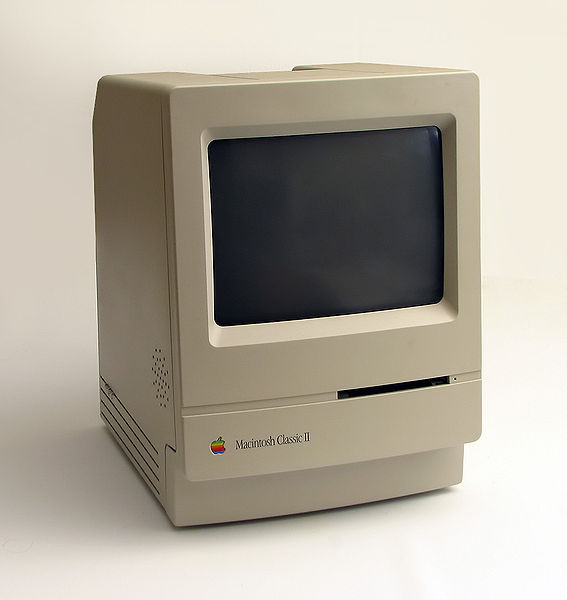
I was naive. Knowing Apple’s great reputation for ease of use, I put the box down in her office space and invited her to open it up and follow the instructions. She would own the entire process from the start.
She opened the box. And she found the ‘read me first’ document. And the other ‘read me first’ document. And the other ‘read me first’ document. Each inserted into the box by some slice of Apple that had something to sell, and none of them offering any useful instructions as to what to actually do with the unit.
I sighed and proceeded to pull the pieces out of the box and put them together. I plugged in the keyboard and mouse and sent the power cord down behind the desk. I crawled under the desk, plugged in it …
And cracked my head on the top of the desk when the machine sprung to life and loudly ejected the plastic shipping biscuit from the floppy disk drive.
This pattern has never improved.
This time around, Karen heard about the wonders of a fit-bit from our eldest, Hannah. She researched the options, picked one out, ordered it up, and waited (with much less anxiety than I would) for its arrival. In the fullness of time, she opened the box and read the instructions:
“Install Our App on your Phone!”
She did that. She launched the app. The app offered two buttons and only two buttons. ‘Setup’ and ‘Login’. The use of ‘Setup’ led to a demand for the use of ‘Login’. Do you see what is lacking from this picture? Yup: no sign of a register button. Karen heaved the canonical sigh of frustration and put it aside until she could catch me.
— “What am I supposed to do?”
— “Well, I suppose you should visit their web site and create an account.”
— “Why don’t the instructions tell me to do that?”
This is a question on par with: “Why does the porridge-bird lay its eggs in the air?” Less politely, why does every single company fail to do even the most basic user experience testing, particularly for the experience of the new user? Grump, Grump, Grump.
After a bit more discussion along these lines, she heads off to the web site, and creates an account. In the last few months, we’ve switched her from using an account on our family Google domain to a plain-old-gmail account. (Why, You ask? Because my lovely employer has still not worked through the initial technical debt of building ‘Google Apps’, and many, many, things still don’t work if your account is in your own domain.)
OK, so, the old account is much quicker to type than the new one. We still own it, and email to it forwards to her new account, so why not use it as an account identifier?
Back went Karen to the phone to log into the FitBit app. Click login? It prefills with the account logged into the phone. Which is, of course, the new account. The UI makes it far from obvious that this is a prefill of a field you can edit, and heaven forfend that it should ask you which of the accounts on your phone you’d like to use. Back to the local tech support department.
“Aha,” sez me. “I bet we can make this easier if we just login to fitbit.com with your Google account instead of having an account defined by an email and password.” Sure enough, fitbit.com allows the creation of an account with a ‘Login with Google’ button. We do that.
Back to the phone. Does the phone app have a ‘Login with Google’ button to match? Nopes. On the phone, where typing is a pain in the fingertips, and a single click would be really valuable, it is nowhere in sight. You have to enter a password that you had to give the website even when creating a ‘Login with Google’ button. Note what company owns Fit-bit. Sigh.
Finally, we have logged in on the phone. And like Alice in Wonderland, having acquired the key to the door, we find ourselves too big to get through it. Once we’ve logged in, there is no longer a ‘Setup a Device’ button in sight. Some searching reveals it buried in ‘My account’: The ‘Add a Device’ option, presumably intended for people planning to wear one fit-bit on each extremity.
Now that we can finally set the thing up, the app finally mentions that it won’t set up until it’s been updated to the latest software. Oh, and it can’t possibly perform an update, even when connected to power, until the battery reaches 50% charge, and that may take an hour. “Can’t Make Me!”
I. Can’t. Even. (As my other daughter might say.)
Charge it up, you say? It comes with a charging adaptor with a 3″ cable with a USB-A connector on it. The very short cable presupposes that you’re going to plug it into a computer rather than a wall-wart; the magnet that holds the fitbit to the charger isn’t that strong, so leaving it dangling on a wall would not be reliable. In any case, there’s no wall-wart in the box. And her laptop, being fairly new, has zero USB-A connectors. Into my older laptop it goes for now.
The year 2010 called and wants its USB-A connectors back. A quick visit to the fitbit support site yields a smarmy support person explaining that fitbit can’t see any reason to accommodate its users by offering a USB-C option, even for extra money. Don’t you love the smell of burning customer satisfaction in the morning?
There’s no visual indication of the charge level; just a flat line reminiscent of a hospital tragedy. The app tells us to try again from time to time. We do. Each time we try and fail, it feels the need to deliver a notification, in spite of the fact that we are sitting right there staring at it.
Finally, enough electrons find their way, the update succeeds, and the device comes to life. Sort of. Up pops a notification, “You need to make a bluetooth pairing for all the functionality to work.” Not in the app, mind you, in the Android notification system. I fire up the Android bluetooth settings, ask to pair a new device … and find only the neighbors’ two Samsung TVs. Apparently, it had already paired on its own.
We’re not done yet. As Karen is working her way though the soi-disant documentation in the app, she finds an option related to notifications. It is completely ambiguous whether this concerns getting notifications from the fitbit on her phone, or notifications from her phone on the fitbit. Can you guess how enthusiastic Karen is about having a buzz on her wrist for IMs, emails, and ‘special offers from fitbit’? Not bloody much. Nonetheless, we travel down this path because we can’t tell from the Oracular pronouncement of the app which way these notifications will go. Only when we’ve dealt with a half-dozen security prompts does it become clear that we’re dealing with the wrong direction — and we have to go disable them all.
Those of you with iPhones may be snickering with self-congratulation here. For all I know, fitbit is one of those companies that prioritizes the posh minority over the hoi polloi of green-dotted plebians. Trust me, however: when our flavor of family cell-phone was Apple, we had just as many of these comic incidents. Our switch to Android had nothing to do with my employment with Google. It happened years earlier, when Apple made a set of changes to the calendar UI so gratuitous that Karen was on the verge of drop-kicking her phone into orbit. Well, OK, Karen would never drop-kick a phone. She would, however, explain to me in very precise detail just how dissatisfied she was with Apple’s decision to move every wheel of her cheese just to satisfy some designer’s urge to … I don’t know. What urges do designers have, anyway?
The fitbit is perhaps tamed. It’s Passover for another hour or two, so perhaps a taste of the bitter herbs of disappointment is seasonal. I can’t see any hope on this Easter Sunday that anyone is going to harrow this particular hell; I’m sure we’ll be visiting it again very soon.
- Blue Time Loops
My birthday came, as birthdays will, a few weeks ago. My children view birthday presents as a challenge: What can they give me that will produce many entertaining stories at the family Zoom? It’s even better if they can come up with a creative challenge to make me sweat. Listening to my son’s stories of his graduate committee, I feel like this present, ultimately, is a small dose of his experience in a photography MFA program. “What work am I making? Where is it going? What does it have to say?”
“OK,” says the reader, “enough. — What Is It?”
Cyanotypes. A relatively simple historical photographic process. Coat paper with some poisonous chemicals. Shine bright light through a negative onto the paper. A quick dip in a bit of hydrogen peroxide, and:
What have we here? To begin with, someone had to spread a solution over a piece of paper evenly, with a minimum of brush strokes. Ignoring the evidence of poor manual dexterity for a moment, what is compelling about this image? It had better not be a pure moment of faux-hipster craft nostalgia. (I am not sure what is plus faux: the idea of me as a hipster, or the hipster trend of incompetent craft masquerading as authenticity (‘Those are artisanal burned spots …’)).
Here is the world seen through a blue haze. Look closely, though, and the details are still there. Seeing is an active process: there’s no LED display in our head; our brains construct our visual experience from the signals of our retinas. ‘Reading’ this image might be pulling some of that unconscious process into our conscious experience. “Oh, look, reflections!” Let’s try another.
A diesel locomotive is a large, solid, noisy, even bright object. Refract it through this process, and it floats in another space. Compare to:
Expecting some comparison? Some rejection of the later in favor of the former? If you were thinking that I’ve completely caught the bug, and have constructed an entirely blueish esthetic model of my future photography …
You’re probably not thinking that. Most of you know that I’m too distractible of a magpie to go there, or too far from any clear vision of why I’m making these images in the first instance. I am very fond of these near-infrared trains as well, and they are about as concrete and present as the cynaotype was abstracted and remote.
So I’ll leave you with a conceptual view of my first day of cyanotypes, brushstrokes and all:
- A Slough Walk with … Slough Film
We went looking for that magic combination for a COVID-Seattle-Winter Weekend day. Not too far away. Not too crowded. Not too wet. Not too steep.
Ebey Slough looked like a good risk. Less than an hour’s drive, flat as an estuary, and a small-scale, municipal park. And, Hey! We could add it to our collection of Seattle Area Sewage Treatment Facilities We Have Seen.
In the fridge I had a roll of Cinestill-50D film, which I had never used. Film stock is a funny thing for us digital-film amphibians. As far as colors go, Photoshop should be able to replicate any look. (aside: Fuji, I’m told, puts countless hours into engineering their digital cameras to mimic various films.) But I’m not very patient with Photoshop. It feels too much like work. Trying out a new film, on the other hand, is like getting a new box of watercolors. The images I got from the Slough, in fact, have a decided resemblance to painting. I can’t say precisely why. I used my Fuji GWS 690 – a ‘modern’ film camera, so it’s not intrinsic soft focus. Maybe the cat drooled in my development tank, creating an unreproducible je-ne-sais-quoi?
There are only eight 6×9 images on roll of 120 film, so at some point these pictures shift over to an old favorite: Kodak Ektar. This was about the point where we shifted from the clear blue sky of the afternoon to the low sun of the early Northern evening.
It feels as if that was the last extended sunshine we’ve seen for weeks, so the images are comforting as I sit in the gloom typing.
- Adventures in 4×5 and the Bathtub
Why create images with Really Big film? (Leaving aside, for the moment, the people out there with even bigger cameras.) Each image is a fussy process of setting up the tripod, setting up the camera, getting everything level, and then working through a checklist out of an aircraft cockpit. All to try to avoid ending up with a blank sheet, a double exposure, or some other D’Oh moment.
A classic justification is the virtue of having to think about each image. This is not a new idea. Recently, I saw a reprint of an article from the early days of roll film. I won’t try to bring a an accurate quotation back from memory. However, you may have read jeremiads lamenting digital photography’s encouragement of the creation of myriads of mediocre images. If so, you would find the sentiment of this article familiar. Only, instead of decrying 200 full frame digital images, or even 36 35mm images, it was a roll of, at most, eight images that set this author to foaming at the mouth.
I have to admit that nothing is stopping me from stopping, and thinking carefully, digital camera in hand.
Perhaps closer to my own motivation is the pleasure of working with my hands. The view camera is a mechanism big enough to see, disassemble, and understand. I tilt the front of the view camera, and I see the image get straighter. I spend all day long at work directing digital traffic, marshaling cohorts of tiny bits of silicon to do tricks. It feels comfortable to work on a smaller scale.
My line of thought here leads to our guest bathtub. Which contains a bucket. Which contains a temperature control device. Can you see where this is going? I’m developing film. When you expose film, you create a latent image. No one can see it until you render it manifest. When I develop film, I work in the dark to bring something to light. I can’t see my hands while I wrestle film onto a holder and put it into the tank, and I can’t watch the chemical process that converts an extremely fragile latent image to a fairly robust negative. To take what I see, visibly, and turn it into what you can see, visibly, I have to wrestle with the invisible.
“Really?,” you might be asking yourself. “He goes to all that trouble just to play word games?”
I won’t deny that this appeals to me, but developing has some other advantages. It takes less time than shipping it off to a lab. The smells tickle old memories; I spent a lot of time in darkrooms in my teenage years. And once again, I’m engaged in a craft with tools that I can manipulate. Without writing a plan, circulating it to a dozen people, holding five meetings, and cajoling a team into implementing, I can accomplish something.
This way lies madness; I could continue along to 19th-century technology where I prepared my own plates and had no dependence on a film factory. I could prepare them with ether. That’s bound to be popular with Karen.
If feel the need to achieve that level of autonomy, I think I had better go learn to draw. Or get some fresh air.
Anyway, here are a few recent results with the 4×5 camera.
In contrast, here’s an image shot with a 6×9 folding film camera that fits in my pocket.
While there is pleasure in working with simpler tools, sometimes the complicated tools let me make things that I’m not otherwise capable of.
Note that I’d never claim that no one could get this image with film (not to mention oil paint), just that I don’t think that I could.